
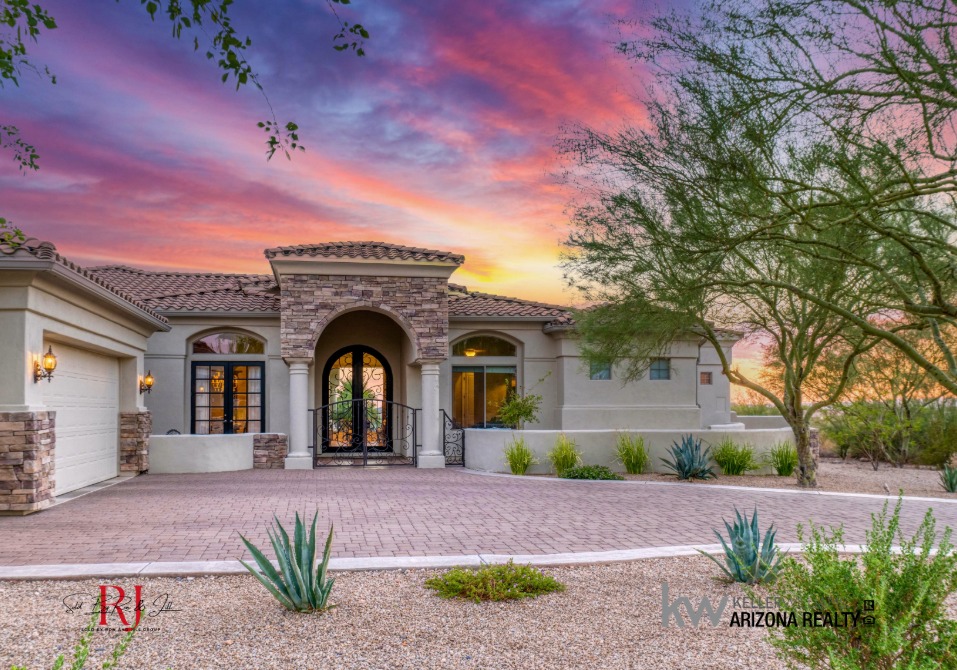
Buying a House As-Is in Phoenix? Pros and Cons to Consider
The Terrain: Phoenix As-Is Inventory in February 2026
The Phoenix Metro market is not what it was three years ago. As-is properties sit in a fundamentally different competitive environment, and the data tells the story before any property tour begins.
- Median sale price: $450,000
- Active listings: 25,267
- Median days on market: 67 days
- Average days on market: 91 days
- Monthly closings: 5,711
- Sale-to-list ratio: 98%
- Maricopa County foreclosure rate: approximately 1% (well below 2008 levels)
- 30-year mortgage rate: approximately 6.63%
West Valley submarket anchors as of February 2026: Buckeye approximately $400,000 (down 3.6% year over year), Goodyear approximately $485,000 (flat), Peoria approximately $535,000 (down 2.7% year over year). Per the Cromford Report and Phoenix REALTORS, the demand-to-supply index sits around 80 — a level senior housing analyst Tina Tamboer described as the strongest buyer opportunity in years.
What this means for an as-is purchase: a property listed as-is in this market is not commanding a premium. It is competing with 25,000+ other listings, many of them turn-key. The seller cannot rely on multiple-offer pressure to push buyers past their due diligence. The buyer who walks in clear-eyed has more leverage in 2026 than at any point in the past five years.
The Weather: What Buyers Are Actually Feeling
Two psychological patterns dominate the as-is buyer pool in Phoenix right now, and both carry risk.
The first is bargain hunger. Buyers who got priced out in 2021 and 2022 see an as-is listing at $50,000 below comparable updated inventory and read it as a deal. Sometimes it is. Often the renovation budget closes that gap and then some — and the buyer ends up paying full retail with extra steps.
The second is foreclosure-narrative confusion. Maricopa County’s foreclosure rate is around 1%, nowhere near 2008 levels. Most “distressed” inventory is investor losses or estate sales, not panicked owners forced to liquidate. A buyer expecting 2008-style steals is operating on stale assumptions. The deals exist, but they require disciplined cost analysis — not opportunism.
What As-Is Actually Means Under Arizona Law
This is the part most buyers and some agents misunderstand. An as-is clause in Arizona does not eliminate seller disclosure obligations. It limits warranty claims. The distinction is the entire ballgame.
The Hill v. Jones Standard
Arizona’s seller disclosure obligations are grounded in Hill v. Jones, 151 Ariz. 81, 725 P.2d 1115 (1986). Under this precedent, sellers must disclose all known material facts about a property — meaning facts a reasonable person would attach importance to in deciding whether to purchase or at what price. The case involved undisclosed termite damage, and the Arizona Court of Appeals held that nondisclosure of a material fact carries the same legal weight as fraud or misrepresentation.
An as-is clause does not override this. A.R.S. Section 47-2316 confirms that “as is” language excludes implied warranties — meaning the seller is not promising the HVAC will work, the roof will not leak, or the plumbing is sound at close of escrow. It does not, however, give the seller permission to hide a known defect. Arizona courts have consistently held that concealing a latent defect — a hidden problem not discoverable through reasonable inspection — is actionable fraud regardless of contract language.
What the AAR As-Is Addendum Does and Does Not Do
The Arizona Association of REALTORS publishes a specific As-Is Addendum that, when executed, supersedes Section 5a of the standard Residential Resale Real Estate Purchase Contract. Practically, the addendum tells the buyer: do not expect repairs. The seller is not making them.
What it does not do:
- It does not waive the buyer’s 10-day inspection contingency under Section 6j.
- It does not waive the seller’s obligation to complete the Seller’s Property Disclosure Statement (SPDS).
- It does not waive the seller’s obligation to deliver the CLUE report (a 5-year insurance claims history).
- It does not waive the buyer’s right to cancel the contract in “sole discretion” during the inspection period and recover earnest money.
The Real Pros: Where As-Is Deals Deliver
The case for as-is purchasing in Phoenix in 2026 is specific. It is not universal.
Price Discount on Cosmetic Inventory
A well-priced as-is home that needs cosmetic work — dated finishes, aged appliances, original carpet, popcorn ceilings — can trade at a 5% to 10% discount to comparable updated inventory in the same submarket. For a buyer in the $500,000 range, that is $25,000 to $50,000 in potential upside if the work is scoped correctly. The math works only when the buyer can execute the renovation at contractor pricing rather than retail homeowner pricing.
Faster Close, Cleaner Transaction
As-is purchases tend to close faster because there is no repair negotiation, no credit request, no contractor access required pre-close, and no Buyer Inspection Notice and Seller’s Response (BINSR) back-and-forth. For buyers in 1031 exchange situations, relocation timelines, or any scenario where speed matters, the cleaner transaction structure has real value.
Less Competition on the Listing
In a 25,267-listing inventory environment with 91-day average days on market, as-is properties typically sit longer than turn-key inventory. Updated homes in Anthem, Litchfield Park, and Peoria can still move in 30 to 45 days. As-is listings often stretch past 90. More time means more leverage, fewer competing offers, and better purchase prices for buyers who can manage uncertainty with proper diligence.
The Real Cons: Where As-Is Deals Go Wrong
For every as-is buyer who clears the renovation under budget, there are two who underestimate cost, timeline, or both.
Inspection Cost Is Now the Buyer’s Cost
A standard Phoenix home inspection runs $400 to $600. A four-point inspection on an older home (roof, electrical, plumbing, HVAC) adds another $200 to $400. Add sewer scope ($150 to $300), termite inspection ($75 to $150), pool inspection if applicable ($150 to $250), and the inspection budget for a thorough as-is review runs $1,000 to $1,800. The buyer pays this whether they close or walk away. On the third as-is property that fails inspection, the cost of due diligence becomes significant.
Repair Cost Estimation Is the Failure Point
Buyers consistently underestimate Phoenix-specific repair costs. A full HVAC replacement on a 2,000-square-foot home runs $9,000 to $14,000. A roof replacement on a tile roof runs $15,000 to $30,000. A pool resurfacing runs $5,000 to $8,000. Foundation repair on Phoenix expansive soils can run $10,000 to $30,000 or more. A buyer who reads “needs some work” as $20,000 in updates and discovers it is actually $65,000 has not gotten a deal. They have paid full price with a renovation hangover.
Financing Friction
Conventional and FHA loans require the property to meet minimum habitability standards at close. An as-is property with peeling exterior paint (FHA flag), a non-functioning HVAC in July (FHA flag), an inoperative pool barrier (Maricopa County code issue), or visible roof damage can fail appraisal review. The buyer then faces three choices: pay cash for the gap, negotiate seller-funded escrow holdback (often refused on as-is), or walk away. Cash buyers do not face this friction. Financed buyers in the $450,000 to $700,000 range should price this risk into every as-is offer.
Hidden Latent Defects
Hill v. Jones gives the buyer recourse for undisclosed latent defects — but the recourse is litigation, not free repairs. A buyer who discovers post-closing that the seller knew about a slab leak, a failed septic system, or prior flood damage and did not disclose has a fraud claim under A.R.S. Section 12-543 with a three-year statute of limitations from discovery. Winning that claim requires evidence of seller knowledge. That evidence is not always available. Insurance claims (CLUE report), prior listing history, and neighbor statements help. Pure latent defects that no one knew about are simply the buyer’s problem.
The Pivot: How to Run the Math Before You Write the Offer
An as-is deal lives or dies in a single number: After-Repair Comp Value minus (Purchase Price + Realistic Rehab Cost + Carry Cost + 10% Contingency). If that number is positive, the deal works. If it is negative or breakeven, walk.
The disciplined process:
- Pull at least three renovated comps in the same submarket within 90 days, similar square footage, similar lot size.
- Get a contractor walk-through estimate during the inspection period — not after. This is non-negotiable on any as-is over $400,000.
- Add 15% to the contractor estimate for surprises. Phoenix homes built before 2000 routinely surface electrical, plumbing, or HVAC issues not visible at walk-through.
- Calculate carry cost — mortgage payment, utilities, insurance — for the realistic renovation timeline. Three months minimum on any project requiring permits.
- Compare to the comp value. If the math does not show at least 8% to 10% margin, the deal is not a deal. It is a renovation project at retail pricing with extra steps.
The honest assessment is: most as-is properties in the Phoenix market do not clear this math. The ones that do are usually purchased by repeat investors or owner-occupants with construction experience. First-time buyers chasing as-is discounts without this discipline routinely end up over-leveraged with deferred maintenance liabilities they cannot afford to address.
Submarket Notes: Where As-Is Inventory Currently Sits
As of early 2026, the West Valley submarkets carry distinct as-is profiles:
- Buckeye ($400K median, down 3.6% YoY): Newer construction stock keeps most rehab cosmetic. Lower entry price but tighter margins on flips. Best for owner-occupants who can absorb a $25K-$40K cosmetic refresh.
- Goodyear ($485K median, flat): Mixed inventory age. Pre-2005 sections offer real renovation upside; newer subdivisions rarely list as-is at meaningful discounts.
- Peoria ($535K median, down 2.7% YoY): Older established areas (north Peoria, Sun City-adjacent) can present 1970s-1990s estate sales with full-renovation upside but significant scope.
- Glendale (mature housing stock): Highest concentration of older as-is inventory in the West Valley. Strongest discount potential, highest hidden-defect risk.
- Surprise ($380K-$430K typical entry): Mostly newer stock; as-is listings here usually trade for estate or relocation reasons rather than condition.
Frequently Asked Questions
For a deeper read on the broader market context, the Sold By Ron and Jill Group blog covers Buying a House With a Septic Tank Near Phoenix: Pros and Cons — a companion piece for buyers evaluating non-standard properties in the West Valley.
For Arizona-specific disclosure law and the Seller’s Property Disclosure Statement, the Arizona Association of REALTORS maintains current forms and guidance at aaronline.com.
Schedule a Consultation with Ron and Jill
An as-is property in the West Valley is a math problem before it is a real estate transaction. The 91-day average days on market gives buyers room to run the analysis correctly: full inspection, contractor walk-through, comparable sales review, financing pre-validation. Ron and Jill work with buyers in the $450,000 to $900,000 range who want intelligence on a specific property — not pressure to write an offer.