
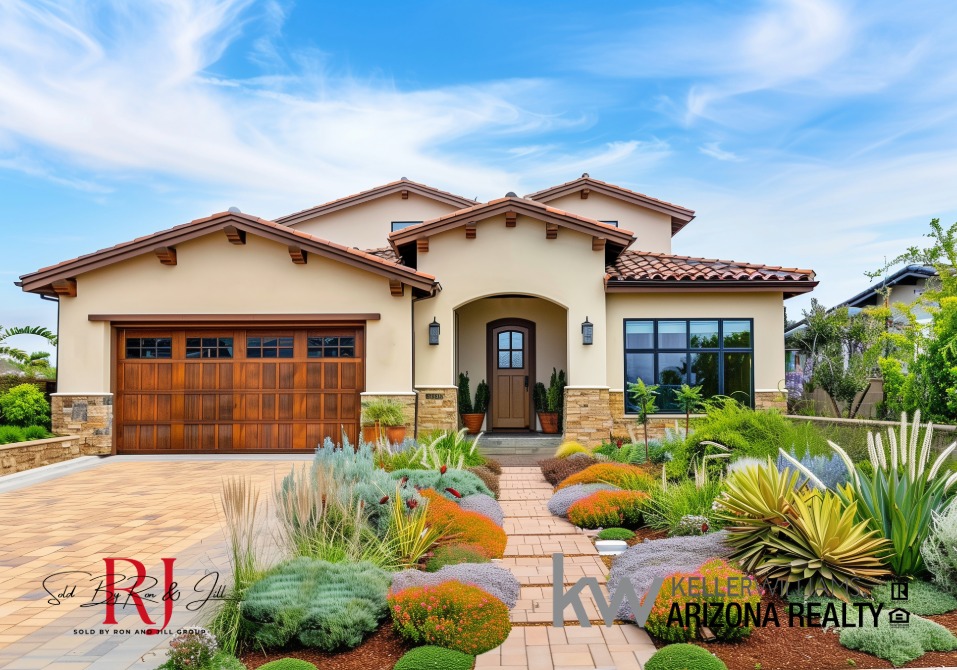
Should You Buy a Model Home in Phoenix? What to Know Before You Do
What a Model Home Is — and How It Comes Available
Every production builder in the Phoenix Metro — Lennar, DR Horton, Pulte, Toll Brothers, K. Hovnanian, Taylor Morrison, Ashton Woods, Meritage — constructs at least one model unit at the opening of each new community. This home is not available for sale during active selling. It functions as the sales office, design inspiration, and proof of concept for the floor plan. Every upgrade option the buyer can choose — quartz countertops, extended patios, tech packages, fireplace surrounds, upgraded cabinetry — is typically installed in the model so prospective buyers can see them in context.
Models typically come available for sale when the community reaches close-out — meaning the remaining unsold lots are few enough that the builder no longer needs the model as a sales tool. In some cases, a builder will sell the model earlier and lease it back from the buyer while the community continues selling. By the time the model is offered for sale, it has been in continuous use as a public-access showroom for anywhere from one to four years.
In the January 2026 Phoenix Metro environment — 24,358 active listings, Cromford Market Index around 80, builders actively scaling back new projects and deploying incentive packages to move remaining inventory — model home close-outs are more available and more negotiable than they were in 2021-2022.
What You Get vs. What You Give Up
| What You Gain | What You Give Up |
|---|---|
| Fully upgraded — no design center spending required | Warranty clock started at construction, not purchase date |
| Move-in ready — no 6-10 month build wait | Flooring, appliances, and fixtures carry 2+ years of foot traffic |
| Furniture may be included or purchased at deep discount | Comparable sales are hard to find — model often not on MLS |
| Builder motivated to close at community end | Builder controls the contract — their form, their terms |
| No future new-home price competition in the community | Builder’s preferred lender may pressure — bring your own |
| Premium lot location (often corner or cul-de-sac) | Sales office use may have damaged bathrooms, garage, carpet |
The Genuine Advantages — In Detail
Every Upgrade Already Installed at Sunk Cost to the Builder
The builder’s model represents the full upgrade menu: premium flooring, designer cabinetry, upgraded appliances, quartz countertops, smart home packages, extended covered patios, and landscaped yards. These were installed to showcase, not to recoup. On a typical West Valley home where the base price might be $380,000 and the full upgrade package adds $60,000-$80,000, the model home buyer can potentially acquire that $60,000-$80,000 in upgrades at a fraction of their installed value — because the builder is pricing for close-out, not for the upgrade menu.
The Furniture May Be Negotiable
Model home staging is typically done by a professional design firm, and the furniture, artwork, window treatments, and decorative items are often includable at discount. West Valley model homes are often staged with $30,000-$60,000 in furnishings. The negotiation rule: ask for furnishings to be included without warranty. The builder does not want warranty exposure on staging furniture. Include “furnishings as-is, without warranty” in the contract language.
Builder Motivation at Close-Out
A builder selling the model is closing a chapter. They want the proceeds, they want to wind down the sales office, and they want to move to the next community. The last model in a finished community is the one with the most buyer leverage — and no concern about future home sales in the community driving down your value. All the homes are already built and sold.
The Warranty Clock Problem — Arizona-Specific
Arizona’s Registrar of Contractors (ROC) mandates a 2-year workmanship warranty from builders — covering structural, plumbing, electrical, and HVAC in years one and two, with structural coverage extending through year 8. The warranty clock typically starts at construction completion, not at your purchase date.
If the model was completed in January 2024 and you purchase it in March 2026, you have approximately nine months remaining on the ROC workmanship warranty from your purchase date. You are not buying two years of warranty coverage.
The good news: under Arizona Supreme Court precedent (Zambrano v. M&RC II LLC, 2022), builders cannot contractually waive the implied warranty of workmanship and habitability. This implied warranty — covering latent defects undiscoverable by reasonable inspection — applies regardless of what the builder’s contract states. Under A.R.S. Section 12-1363, homeowners can file a formal Notice of Construction Defect to trigger the builder’s right-to-repair obligation. Latent structural defects discovered years later may still be actionable.
The Builder’s Contract Is Not the AAR Contract
When you purchase a resale home, you use the AAR Residential Resale Real Estate Purchase Contract — a standardized form with well-defined consumer protections. When you purchase a model home, you sign the builder’s proprietary purchase agreement, written by the builder’s attorneys to protect the builder’s interests.
- The builder’s contract typically does not include the AAR 10-day inspection period with sole-discretion cancellation. Your inspection rights are defined by what the builder agrees to in their document.
- Earnest money in builder contracts often has very limited or no refund window — not the broadly protective cancellation rights of an AAR contract.
- Rate buydown incentives may be conditioned on using the builder’s preferred lender. You are never required to use that lender — but you may lose the incentive if you don’t.
- Escalation clauses, price adjustment rights, and unilateral completion date changes may be embedded in the builder’s standard contract.
The Negotiation Playbook: What to Ask For
1. Price Below Comparable New Sales in the Community
The model has wear and tear, a shortened warranty, and presents differently to an appraiser than a new build. Your agent should pull recent closed sales within the community to establish a comp baseline. The discount should reflect: remaining warranty period, condition of high-traffic areas, and the builder’s close-out motivation.
2. Furnishings Without Warranty
Standard contract language: “Buyer accepts furnishings in their current as-is condition, without warranty, without additional consideration.” This removes the builder’s liability concern and converts their furniture removal cost into value for you. The framing that works: “We will take the furnishings off your hands, as-is, with no warranty claims.”
3. Warranty Reset From Purchase Date
Negotiate explicitly that the ROC workmanship warranty runs from your purchase date, not construction completion. Expect resistance — but a motivated close-out builder may accept it. This is the most valuable contractual protection you can secure on a model home.
4. Rate Buydown or Closing Cost Credit
In the current Phoenix environment, production builders are offering meaningful rate buydown incentives on inventory homes. A model home close-out buyer should ask for the same incentive package available on spec homes. Builders track incentives separately from home price — you may be able to negotiate a market-rate price AND an incentive package.
5. Specific Repairs and Replacements Before Close of Escrow
Order a third-party inspection before submitting the offer or early in the contract period. Document every item showing wear from public use: carpet condition, bathroom fixture wear, landscape irrigation, garage floor, appliance operational state. Use the inspection report to negotiate specific repairs as a condition of purchase — not just credits.
The Leaseback Consideration
If the builder proposes or you negotiate a leaseback — the builder pays you rent while continuing to use the model as the sales office — here is the structure to understand. The builder pays market-rate rent during the leaseback period, which helps offset your carrying costs. At the end of the leaseback, the home reverts to you.
The risk: conduct a pre-leaseback walkthrough with photos documenting every surface condition. Conduct a post-leaseback walkthrough with the same rigor before releasing the builder from leaseback obligations. Any damage during the leaseback is the builder’s responsibility — but proving it without documentation after the fact is significantly harder.
Phoenix 2026 Market Context: Why Model Home Timing Is Good Now
- Builder inventory pressure: Production builders are scaling back new community starts across the West Valley. Close-out model sales are happening in Goodyear (Estrella, Palm Valley), Surprise (North Surprise communities), Peoria (Vistancia, P83 corridor), and Buckeye (Verrado, Tartesso, Sundance).
- Rate buydown environment: Builders are offering 2.99%-3.99% temporary buydown rates and permanent rate incentives. A model home close-out buyer should insist on the same incentive access as spec home buyers.
- No bidding war: Model homes are typically not listed on MLS and are not subject to competing offer dynamics. You are negotiating with one motivated seller.
- Completed community = no construction disruption: Buying a model in a completed community eliminates noise, dust, and early-morning construction crews that accompany early-phase purchases.
When to Walk Away From a Model Home
- Warranty clock is expired or nearly expired and the builder won’t reset it to your purchase date — the key new-construction selling point is materially gone.
- Builder refuses any inspection. No legitimate reason exists to refuse a third-party inspection on a home that passed construction inspection. Walk away.
- Sales office damage is unaddressed and the builder declines to make it right before close. The cost of remediation belongs in the price, not your post-close budget.
- The lender incentive math doesn’t work. If the builder’s incentive package requires their lender at materially worse terms, run the full 30-year mortgage math, not just the monthly payment at the buydown rate.
- The HOA has unresolved issues. A close-out model in a community with HOA litigation, deferred common area maintenance, or an underfunded reserve fund is inheriting liabilities that won’t appear in the builder’s sales presentation.
Frequently Asked Questions
The builder’s fully upgraded showcase unit — open for tours, professionally staged, and built to demonstrate all upgrade options available in the community. Models come available for purchase at community close-out when the builder no longer needs them for marketing, or sometimes sold earlier with a leaseback arrangement.
Not necessarily cheaper by list price, but often more value per dollar because they include all upgrades already installed. The opportunity is buying $60,000-$80,000 in upgrades at a price reflecting wear, reduced warranty, and builder close-out motivation — rather than paying the upgrade price on a new build.
Arizona builders must provide a 2-year ROC workmanship warranty, with structural coverage through year 8. The critical issue: this warranty typically runs from construction completion, not your purchase date. Negotiate a reset to your purchase date. Additionally, under Zambrano v. M&RC II LLC (Arizona Supreme Court, 2022), builders cannot waive the implied warranty of workmanship and habitability regardless of what the contract states.
Yes. Standard practice: negotiate furnishings included “as-is, without warranty.” This removes the builder’s liability concern and converts their staging furniture removal cost into value for you. Model home furnishings can represent $30,000-$60,000 in value you can often secure at no additional consideration.
Yes — and register with an agent on your first visit. Some builders require agent accompaniment on the first visit to recognize them as your representative. The builder’s sales agent works for the builder. Your buyer’s agent reviews the proprietary contract, coordinates third-party inspections, and negotiates in your interest. Also see: Should You Make a Clean, No-Contingency Offer in Phoenix? for how builder contract contingencies differ from AAR resale contracts.
Yes, always. You are never required to use the builder’s preferred lender. Some builder incentives may be conditioned on their lender. Compare the full 30-year math of the builder’s incentive package against what you can obtain independently — not just the monthly payment at the buydown-assisted rate.
Order a comprehensive third-party inspection covering all standard systems plus model-specific concerns: carpet compression in high-traffic areas, bathroom fixture condition, appliance operational state and remaining manufacturer warranties, landscape irrigation functionality, garage floor and door condition, and any areas that were used as a sales office. Use findings to negotiate specific repairs — not just credits — before close of escrow.
The buyer purchases the model but allows the builder to continue using it as the sales office for a defined period (typically 6-12 months), paying rent to the buyer. This helps offset carrying costs. Conduct thorough pre-leaseback and post-leaseback walkthroughs with photo documentation to establish baseline condition and protect against damage during the leaseback period.
The Model Home Verdict: When It Works
A model home in Phoenix is a legitimate opportunity when the timing aligns: a close-out community with a motivated builder, a warranty position reset to your purchase date or priced to reflect actual remaining coverage, a third-party inspection confirming the home’s condition matches its presentation, and a buyer who wants fully upgraded without a 6-10 month construction timeline.
It is not a shortcut past due diligence — it is a different form of due diligence. Get your own agent. Get your own inspector. Get your own lender quote. Then decide if what you are buying justifies what you are paying. Ron and Jill work with buyers evaluating both resale and new construction across the West Valley — including model home close-outs in Goodyear, Surprise, Peoria, and Buckeye.