
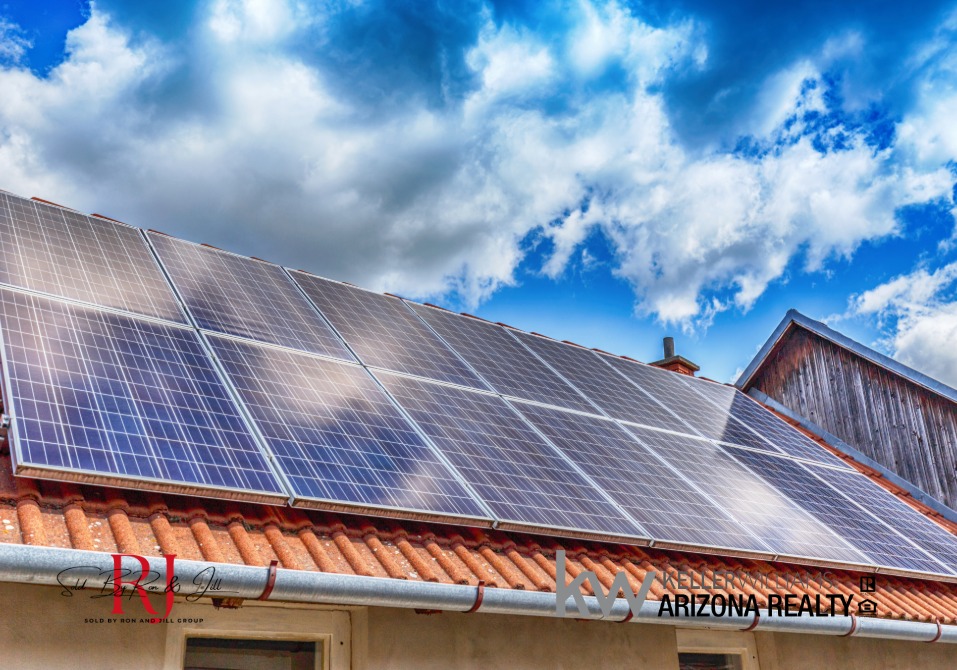
8 Questions Phoenix Buyers Should Ask Before Buying a House With Solar Panels
Solar panels on a Phoenix home can represent a genuine financial benefit or a financial liability disguised as a green feature — and the determining factor is almost always who owns the system. An owned solar system is real property that can add appraised value and passes to the buyer at close. A leased solar system is not owned by the homeowner, carries a monthly payment the buyer may have to assume, creates a UCC-1 lien on the title that must be resolved, and typically adds zero appraised value. Arizona’s net billing environment (not net metering), the APS vs. SRP export rate difference, production records, inverter age, roof warranty status, and the AAR Solar Addendum disclosure requirements round out the eight questions every Phoenix buyer needs answered before proceeding on a solar-equipped home.
The Terrain: Solar in Phoenix’s 2026 Market
Phoenix averages approximately 299 sunny days per year, making Maricopa County one of the highest solar production environments in the United States. A significant share of West Valley resale inventory — particularly in communities built from 2015 forward in Goodyear, Peoria, Surprise, and Buckeye — carries existing solar installations. Some were installed by original homeowners, others by builders as standard or optional features. The systems range from owned (purchased outright or financed on a solar loan) to leased (equipment owned by a third-party solar company with a monthly payment structure).
Arizona transitioned away from traditional net metering in 2017 to a net billing system, where excess solar generation is credited at a rate below the retail electricity price. As of 2026, APS credits excess generation at approximately $0.076 per kWh against a retail rate around $0.15 per kWh. SRP’s export rate is significantly lower — approximately $0.028 per kWh. SRP transitioned all new solar customers to net-billing time-of-use rate plans in late 2025. One critical protection: the export credit rate is locked in for 10 years from the date the system is interconnected with the grid.
The ARMLS January 2026 Phoenix Metro median was $444,740. Solar adds complexity to transactions at every price point — but the stakes are highest in the West Valley’s $400K–$550K inventory tier, where a $150/month solar lease payment materially affects qualifying DTI, and where buyers are most likely to encounter homes with 7–12 year old systems approaching inverter replacement windows.
The Weather: What Buyers Assume That Gets Them in Trouble
The most common buyer error on solar-equipped homes is treating “solar panels on the roof” as a simple positive. It feels like an asset. The listing may frame it as a selling point. The seller may present low utility bills as evidence of financial benefit. None of that analysis is complete without knowing who owns the system, what terms are attached to it, and what it will cost — directly or indirectly — to take it over.
A buyer who closes on a leased solar system without reading the lease may discover post-close that they assumed 14 more years of a $175/month payment with a 2.9% annual escalator, that the lease was not transferable from a financing standpoint and their lender counted it against their DTI anyway, and that the system has an older inverter approaching end of warranty with no service contract in place. These are not hypothetical scenarios — they are documented closing complications in the Phoenix market.
The AAR Solar Addendum (November 2025): The Arizona Association of REALTORS® released a Solar Addendum as part of its November 2025 forms update. This form establishes specific contingency timelines for solar lease disclosure and transfer, protecting buyers by requiring disclosure of lease terms during the inspection period and establishing a buyer qualification timeline. Buyers purchasing any Phoenix home with a leased solar system should ensure this addendum is part of the purchase contract. The seller’s obligation to disclose leased systems is also addressed under A.R.S. §33-422.
This is the foundational question from which every other solar consideration flows. The answer determines whether the system has appraised value, whether there is a lien on the title, whether the buyer assumes a monthly obligation, and how the transaction is structured.
Owned (paid cash): The system is real property, passes to the buyer at close, has no lien, and can contribute to the appraised value of the home. The simplest scenario in a solar real estate transaction. Verify documentation of ownership and confirm no UCC-1 was filed during a prior financing period that was never terminated.
Financed (solar loan): The buyer owns the system but has an outstanding loan. Some solar loans are recorded as liens against the property (particularly PACE loans — Property Assessed Clean Energy loans, which are collected through the property tax bill). PACE loans in particular require special attention because they transfer with the property and become the buyer’s obligation at close. Ask specifically whether the solar financing is a PACE loan, a personal loan, or a home equity instrument.
Leased or PPA (Power Purchase Agreement): The solar company owns the equipment. The homeowner pays monthly for the right to use the energy produced. This structure involves a UCC-1 filing, a lease agreement with specific transfer provisions, and a credit qualification requirement for the buyer to assume it. If the buyer does not qualify or does not want to assume the lease, the seller must buy it out or arrange removal before or at closing.
Before making an offer on a home with a leased solar system, request a copy of the full lease agreement. The terms that matter most:
| Lease Term to Review | What to Look For | Red Flag Scenario |
|---|---|---|
| Monthly payment | Current dollar amount; when it was established | Payment exceeds monthly utility savings from system |
| Escalator clause | Annual percentage increase in payment (commonly 1–3%) | 2.9% annual escalator over 15 remaining years multiplies total cost materially |
| Remaining term | How many years remain on the lease (20–25 year initial terms are common) | 15+ years remaining with escalator means substantial total obligation |
| Buyout provision | Can the lease be bought out, and at what cost? | High buyout price relative to system age and remaining term |
| Transfer conditions | Is the lease transferable? Does the buyer need credit approval? | Non-transferable lease with no buyout option — seller must remove or negotiate |
| Production guarantee | Does the lease guarantee a production level? If so, what is the remedy? | No production guarantee: lease payment counts against buyer’s DTI in mortgage qualification |
PACE loans deserve particular scrutiny. Unlike a standard solar loan, a PACE loan is typically recorded as a special assessment against the property and collected through the property tax bill. It does not disappear at closing — it transfers to the buyer. Some lenders will not originate a mortgage on a property with an outstanding PACE lien without specific loan program eligibility. Ask the seller explicitly: is this a PACE loan? And request the county assessor’s property tax bill showing any special assessment.
Solar production declines over time. Standard panel degradation is approximately 0.5% per year, meaning a 10-year-old system produces roughly 5% less than when installed. But degradation is not the only production variable — inverter efficiency, panel soiling (dust and bird debris are significant in Phoenix’s desert environment), shading from tree growth or added structures, and orientation all affect output.
Request the last 12 months of utility bills alongside the solar monitoring app report for the same period. Compare what the system is producing against what the installer originally promised. If the seller claims the system covers 85% of the home’s electricity needs but the monitoring data shows 60% production relative to consumption, that gap represents a cost the buyer will carry — not the savings the listing implies.
Also confirm the buyer’s home energy use patterns. A home with two electric vehicles charging overnight, a hot tub, and a casita will have very different consumption patterns than the single occupant household for whom the system was sized. A system that “perfectly covered” the previous owner’s usage may fall well short for a family of five with a pool and two EVs.
APS and SRP are not interchangeable, and the financial value of an existing solar system differs materially between them.
| Factor | APS (Arizona Public Service) | SRP (Salt River Project) |
|---|---|---|
| Export credit rate (2026) | ~$0.076/kWh | ~$0.028/kWh (much lower) |
| Regulatory body | Arizona Corporation Commission | Independent public power utility (not ACC regulated) |
| Rate lock for existing solar | Export rate locked 10 years from interconnection | Export rate locked 10 years from interconnection; new customers on TOU plans |
| New solar customer plan (2025+) | Time-of-use plans with net billing | E-28, E-16 TOU net-billing plans (demand management critical) |
| Monthly fixed charge | ~$12/month base | ~$32/month base (higher fixed cost regardless of usage) |
| Demand charges | Present on some APS solar plans (highest 60-min peak) | Present on SRP solar plans (highest 30-min peak) |
SRP’s lower export credit rate means solar systems in SRP territory typically produce less financial offset than equivalent systems in APS territory. Confirm the utility by address (not city name, as territory boundaries do not follow city lines) and ask when the system was interconnected — this establishes when the 10-year export rate lock expires. A system interconnected in 2019 has its rate locked through 2029. A system interconnected in 2014 may already be on a post-lock reduced rate.
When a solar company leases panels to a homeowner, it typically files a UCC-1 financing statement (sometimes called a fixture filing) to establish its ownership interest in the equipment. This filing appears in the title search and must be resolved before the property can transfer with clear title.
There are three ways to clear a UCC-1 on a leased solar system at closing: the buyer qualifies for and assumes the lease (the solar company updates the filing to reflect the new owner), the seller pays off and terminates the lease (the company files a UCC-3 termination statement, which should appear on the title), or the solar system is removed and the roof is restored (relatively rare, typically used when no other option exists). Buyers should ensure their escrow officer identifies any UCC filings early and confirm a specific resolution path — not just the intent to resolve — before their inspection contingency expires.
The timeline risk: Solar lease transfer processes typically take 2–6 weeks. The solar company must receive forms from both parties, run a credit check on the buyer, and issue approval. If the buyer’s lender also has specific requirements for leased solar (which many do), add another underwriting review cycle. Initiating the lease transfer process immediately after opening escrow — not after the inspection period — is the correct sequence. The AAR Solar Addendum (November 2025) establishes specific timelines for this process.
Appraisal treatment of solar systems depends entirely on ownership structure and comparable sales in the neighborhood.
Owned systems: An owned solar system is real property and can be included in the appraised value. However, the appraiser must find comparable sales of homes with owned solar systems to support a value adjustment. In West Valley submarkets where solar adoption is high, comps may exist. Where they do not, the appraiser may make no adjustment regardless of what the seller paid for the system. A $25,000 solar installation may add $5,000–$12,000 in appraised value — or zero. The gap between installation cost and appraised value is a seller expectation problem, not a buyer problem — but it affects the negotiation if the seller has priced the home with a full solar premium.
Leased systems: Leased systems are generally not counted in the appraised value. The homeowner does not own the asset; from the appraiser’s and lender’s perspective, the solar equipment is personal property belonging to the solar company, not a home fixture with transferable ownership. Fannie Mae, Freddie Mac, FHA, and VA guidelines all treat owned and leased solar differently, and leased systems carry no value for appraisal purposes under standard guidelines.
A solar system has two distinct warranties that buyers should document:
Panel product warranty (typically 10–25 years): Covers manufacturing defects in the panel itself. Most major manufacturers offer 25-year warranties. Confirm the manufacturer is still in business — several solar panel manufacturers have exited the market, leaving homeowners with warranty instruments that have no enforceable counterparty.
Panel performance warranty (typically 25 years): Guarantees that output does not degrade more than a specified percentage per year (usually less than 0.5%/year, or 80–90% of original output at 25 years). Request the degradation spec sheet and ask the seller for the most recent monitoring report showing actual production.
Inverter warranty (typically 10–15 years): The inverter converts DC electricity from the panels to AC current the home can use. It is the component most likely to require replacement first — and it is not typically covered by the panel warranty. A system with 13-year-old inverters on a 10-year inverter warranty is outside the warranty window. Inverter replacement costs $1,500–$4,000+ depending on the system size and type. Ask the seller for the inverter brand, model, age, and warranty documentation.
Installer workmanship warranty (typically 10 years): Covers the installation work, including roof penetrations and electrical connections. Confirm the solar installer is still in business and honoring warranties. Some Phoenix-area solar installers from the 2015–2020 boom period are no longer operating.
This is the question most buyers never think to ask — and one of the most consequential in Phoenix’s climate. Solar panel installation requires roof penetrations for mounting hardware and conduit runs. Those penetrations frequently void the original roofing contractor’s warranty or the roofing manufacturer’s warranty, because the roofing system’s integrity was altered by a party other than the original roofer.
Ask the seller: does the roof still have an active warranty? Was the original roofer notified and did they approve the solar installation? Did the solar installer provide their own roof penetration warranty, and for how long? The answers determine whether a roof problem discovered after closing is covered by anyone — or whether it is entirely the buyer’s financial exposure.
In Phoenix’s climate, a standard asphalt shingle roof lasts 12–20 years. A concrete tile roof lasts 30–50 years. If the roof is approaching the end of its expected lifespan and the warranty was voided by solar installation, the buyer inherits both the solar system and the roof replacement cost with no warranty backstop on either the roof or the penetration points. A separate roof inspection — distinct from the general home inspection — is appropriate on any solar-equipped home, particularly where the roof age is within 7 years of expected end of life.
The 8 Questions at a Glance
| # | Question | Key Risk if Unanswered |
|---|---|---|
| 1 | Owned, financed (PACE?), or leased? | Unknowing assumption of PACE lien or lease obligation |
| 2 | What are the specific lease/PACE terms? | Hidden escalator, non-transferable lease, or buyout cost surprise |
| 3 | What is the system actually producing? | Paying for a system that underdelivers against the seller’s claims |
| 4 | APS or SRP? What rate plan and export credit rate? | Overestimating financial value of system in SRP territory or post-rate-lock |
| 5 | Is there a UCC-1 on title, and how is it being resolved? | Closing delay or title complications from unresolved fixture filing |
| 6 | How will the appraisal treat the system? | Appraisal gap if seller priced a full solar premium on a leased system |
| 7 | Are panel and inverter warranties still active? | Inheriting out-of-warranty inverter with imminent $2,000+ replacement |
| 8 | Was the roof warranty voided by solar installation? | Roof problem post-close with no warranty coverage on penetration points |
Frequently Asked Questions
Do leased solar panels transfer to a buyer in Arizona?
They can, but the transfer is not automatic. The solar company must approve the buyer, which typically involves a credit check. The buyer must be willing to assume the remaining lease term and monthly payment. The lease payment will generally count against the buyer’s debt-to-income ratio in mortgage qualification unless the lease includes a production guarantee. If the buyer does not qualify or does not want to assume the lease, the seller must either buy it out or arrange removal before closing.
Does owning a home with solar panels in Phoenix add to the home’s appraised value?
Only if the system is owned outright, and only if comparable sales with similar systems exist in the neighborhood to support an adjustment. Owned systems can add appraised value, though typically less than the installation cost. Leased systems are generally not counted in the appraised value because the homeowner does not own the equipment.
What is the difference between APS and SRP net billing in Phoenix?
Both operate under Arizona’s net billing system (not net metering). APS credits excess solar generation at approximately $0.076 per kWh as of 2026. SRP’s export rate is significantly lower — approximately $0.028 per kWh. Export rates are locked for 10 years from the system’s interconnection date. Buyers should confirm which utility serves the property and when the 10-year rate lock expires.
What is a UCC-1 filing and how does it affect buying a Phoenix home with leased solar?
A UCC-1 financing statement is filed by the solar company to establish its ownership of the leased equipment. It appears on the property’s title search and must be resolved before closing. Resolution options include: the buyer assuming the lease, the seller buying out the lease, or removal of the system. The process can take 2–6 weeks and should begin immediately after opening escrow.
Are sellers required to disclose solar systems in Arizona?
Yes. Under A.R.S. §33-422 and the SPDS disclosure obligations, sellers must disclose alternative power systems. For leased systems, sellers must identify that the system is leased and provide the leasing company’s information. The AAR Solar Addendum (November 2025) establishes specific timelines for lease disclosure and transfer contingencies. The full lease should be attached to the SPDS for buyer review during the inspection period.
Does a solar panel installation void a roof warranty in Phoenix?
Often yes. Roof penetrations required for solar installation commonly void the original roofing contractor’s or manufacturer’s warranty. Some solar installers offer their own roof penetration warranty covering the areas they penetrated, typically limited to 10 years. Buyers should ask the seller for documentation of the roof’s current warranty status and should include a separate roof inspection in their due diligence on any solar-equipped home.
What panel and inverter warranties should I look for when buying a Phoenix solar home?
Panel product warranties (10–25 years) cover manufacturing defects. Performance warranties (typically 25 years) guarantee output does not degrade more than approximately 0.5% per year. Inverter warranties (10–15 years) cover the component most likely to fail first, at a replacement cost of $1,500–$4,000+. Confirm all warranties are still active and that the manufacturers and installer are still in business and honoring claims.
How does a solar lease payment affect mortgage qualification when buying a Phoenix home?
Under most mortgage guidelines, a solar lease payment counts against the buyer’s debt-to-income ratio unless the lease includes a production guarantee. On a $150/month solar lease at a 43% back-end DTI threshold, the buyer needs approximately $4,200/year in additional qualifying income to offset the payment. Buyers should share the full lease with their lender before making an offer and get a clear determination on DTI impact.
Solar Is a Feature. Knowing What It Means Is a Strategy.
The West Valley’s solar-equipped inventory is substantial and growing. Buyers who understand the 8 questions before touring make better offers, negotiate more effective contract protections, and avoid the post-close surprises that show up when lease terms and inverter warranties are not reviewed until it is too late. Ron and Jill work with buyers across Goodyear, Peoria, Surprise, and Buckeye navigating exactly these transactions. Schedule a consultation before you make an offer on a solar-equipped home.
🤝 Agent ReferralWebsite: soldbyronandjillgroup.com
Search Listings: soldbyronandjill.com
YouTube: @SoldByRonAndJillGroup



How Much Does a Home Warranty Cost in Phoenix?
How Much Does a Home Warranty Cost in Phoenix? | Sold By Ron and Jill Group How Much Does a

Spec Homes in Phoenix: What to Know Before Buying
Spec Homes in Phoenix: What to Know Before Buying | Sold By Ron and Jill Group Spec Homes in Phoenix: