
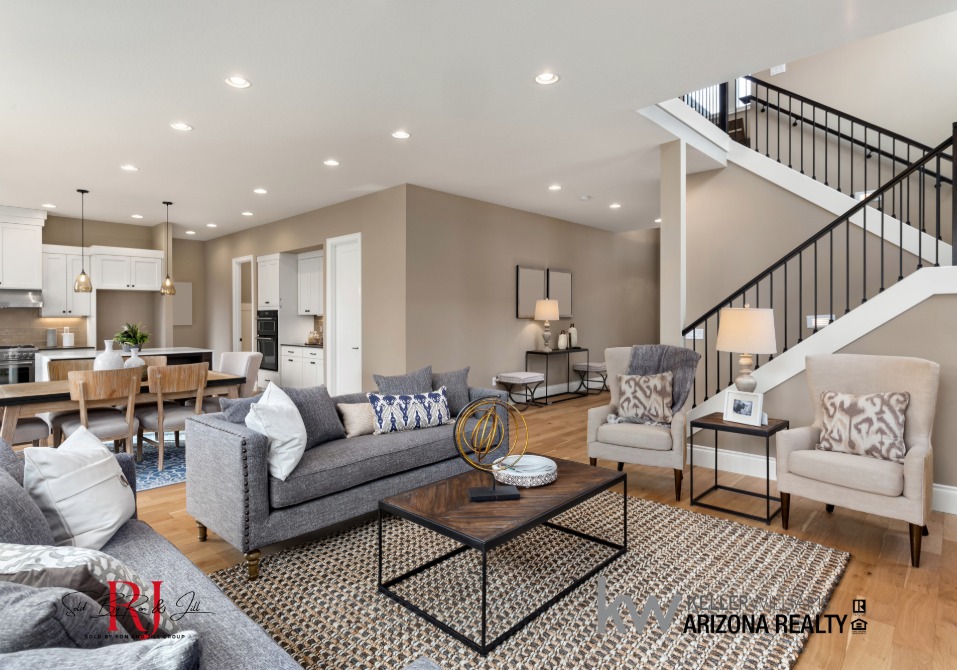
Primary Residence in Arizona: What It Means and Why It Matters for Phoenix Buyers
The Terrain: What the Current Market Looks Like for Primary Residence Buyers
ARMLS January 2026: 24,358 active listings, $444,740 median sale price, 94 average days on market, 5.17 months supply, 59.6% of closings below list price. West Valley entry range $380,000–$434,000.
At $444,740 median, the tax, rate, and capital gains implications of how a property is classified are proportionally larger than they were when Phoenix medians were $250,000. A 0.625% rate difference between a primary residence loan and an investment property loan on a $400,000 mortgage represents approximately $53,000 in additional interest over 30 years. Understanding the classification system is not a legal technicality — it is financially material.
The Weather: What Buyers Often Misunderstand
Two misunderstandings are common. The first is that “primary residence” means wherever you sleep most nights — a loose definition that does not survive lender or assessor scrutiny. The second is that primary residence status is automatic upon purchase. In Arizona, it is not. The property tax classification must be applied for through the Maricopa County Assessor’s office. Many buyers who close and do nothing find their property classified as non-primary (Class 4.1) by default, paying higher taxes and missing the Homeowner’s Rebate because they did not file the required documentation.
How Arizona Law Defines Primary Residence
Arizona Revised Statutes 42-12053 defines the criteria for distinguishing primary residential property. The most important factor is the length of time the owner resides on the property — but no single factor is dispositive. The Maricopa County Assessor uses multiple indicators:
- The address listed on the owner’s state and federal income tax returns
- The address on the owner’s driver’s license or state ID
- The address on the owner’s voter registration card
- Whether the owner has claimed a homestead exemption or similar primary residence treatment in another state
- The location where the owner’s spouse and minor children reside
- The state and county where the owner’s children attend K-12 schooling
- Motor vehicle registration address
Arizona Property Classifications: Class 3 vs. Class 4
Arizona taxes real property based on its use classification. For residential property, Class 3 (primary residence) and Class 4 (non-primary or rental) are the two classifications that matter most to Phoenix buyers:
| Class | Property Type | Assess. Rate | Primary Tax Benefits |
|---|---|---|---|
| 3.1 | Owner’s primary residence | 10% | 1% primary tax cap; Homeowner’s Rebate (up to $600/yr) |
| 3.2 | Qualified family member primary residence | 10% | 1% primary tax cap; Homeowner’s Rebate |
| 3.3 | Primary residence + lodger rental | 10% | 1% primary tax cap; Homeowner’s Rebate |
| 4.1 | Non-primary residence (vacation home, unoccupied) | 10% | No 1% cap; No Homeowner’s Rebate |
| 4.2 | Residential rental property | 10% | No 1% cap; No Homeowner’s Rebate |
Both Class 3 and Class 4 carry a 10% assessment rate. The financial difference is entirely in two benefits that apply exclusively to Class 3 property:
Benefit 1: The 1% Primary Tax Cap
The Arizona Constitution limits the combined primary tax rate from all jurisdictions (county, city, school district, community college) on Class 3 property to no more than 1% of the property’s combined Limited Property Value. When tax rates would otherwise exceed this cap, excess school district taxes are reduced and the state provides additional aid. Class 4 property does not receive this cap protection. Reference: Maricopa County Assessor — Update My Legal Class (mcassessor.maricopa.gov).
Benefit 2: The Homeowner’s Rebate (State Aid to Education)
The Arizona Legislature annually appropriates money to pay a portion of the primary school district tax on Class 3 owner-occupied homes. This rebate appears on the property tax bill as “STATE AID TO EDUCATION” and is capped at $600 per year under current Arizona law. It appears automatically on the tax bill once the property is correctly classified as Class 3 — no separate application required. Removing Class 3 status removes the rebate for subsequent tax years.
How to Establish and Maintain Class 3 Status in Maricopa County
Class 3 status is not automatic upon purchase. File a Request for Residential Legal Class Change form with the Maricopa County Assessor’s office, with one of the following documentation combinations:
- Driver’s license displaying the owner’s name and the property address, OR
- Voter Registration Card displaying the owner’s name and the property address, OR
- Partial Federal or State Tax Return (name and address section only) PLUS one of: Motor Vehicle Registration or Utility Bill showing the owner’s name and property address
Mortgage Implications: Rate, Down Payment, and Program Eligibility
For lenders, occupancy type is a fundamental underwriting variable. The three occupancy categories carry different risk profiles and loan terms:
Primary Residence: Best Available Loan Terms
Owner-occupied primary residence loans offer the lowest available interest rates, the lowest minimum down payments, and the broadest access to loan programs:
- Conventional: 3% minimum down payment; rates at or near baseline
- FHA: 3.5% down with 580+ FICO
- VA: 0% down for eligible veterans; no PMI
- USDA: 0% down in eligible rural/suburban areas
Second Home: Higher Rate, Larger Down Payment
A second home must typically be at least 50 miles from the buyer’s primary residence and cannot appear to be purchased for rental investment purposes. Second home financing carries higher interest rates (typically 0.375%–0.625% above primary residence rates) and requires a minimum 10% down payment under most conventional guidelines. Down payment assistance programs are not available.
Investment Property: Highest Rate, Largest Down Payment
Investment property loans carry rates 0.625%–1.125% above primary residence rates. Minimum down payments are 15%–25% depending on loan type. PMI is typically not available. Investment property purchases are not eligible for FHA, VA, USDA, or any DPA programs.
The Federal Capital Gains Exclusion Under Section 121
The most significant long-term financial benefit of primary residence status is the federal capital gains exclusion under Internal Revenue Code Section 121 (26 U.S.C. 121).
Exclusion Amounts
Single filers: Up to $250,000 of capital gain excluded from federal income tax. Married couples filing jointly: Up to $500,000 excluded. These amounts have not been inflation-adjusted since 1997. In the current Phoenix market, where a home purchased for $300,000 a decade ago may now sell for $500,000 to $600,000, the Section 121 exclusion is often the difference between a large federal tax bill and no federal tax at all on the sale.
The Two-Year Rule (Ownership and Use Tests)
To qualify for the full exclusion, the seller must have both owned the property AND used it as their primary residence for at least 2 of the 5 years ending on the date of sale. The two years do not have to be consecutive.
- Ownership test: Must have owned for at least 2 years (730 days) during the 5-year period before sale. For married couples filing jointly, only one spouse needs to satisfy this.
- Use test: Must have used the property as primary residence for at least 2 years (730 days) during the same 5-year period. For married couples filing jointly to claim the full $500,000 exclusion, both spouses must independently satisfy the use test.
- Frequency limit: The full exclusion can be claimed once every 2 years.
Practical Math for Phoenix Buyers: The Section 121 Exclusion in Action
A couple purchased a home in Goodyear in 2020 for $350,000. In 2026, they sell for $520,000 with $18,000 in selling costs.
Gain calculation: $520,000 – $350,000 – $18,000 = $152,000 capital gain
Section 121 exclusion available: Yes — they have owned and used it as primary residence for more than 2 of the past 5 years.
Federal capital gains tax owed: $0. The entire $152,000 gain is excluded.
If the property had been classified as a rental for 3 of those 6 years, depreciation claimed during the rental period would be subject to recapture at up to 25% tax rate. The tax outcome changes materially.
What ‘Primary Residence’ Means at the Mortgage Closing Table
The mortgage note and deed of trust a buyer signs at closing include an occupancy certification. The buyer certifies they intend to occupy the property as their principal residence within 60 days of closing and to continue occupying it as their principal residence for at least one year. This is a legal representation, not a preference.
Frequently Asked Questions
What is the difference between a primary residence and a second home in Arizona?
A primary residence is your main home — where you live more than 7 months per year (Maricopa County Assessor’s operational standard) and designate as your one and only primary residence. A second home is a property you own but do not occupy as your primary — typically a vacation home or property used part-time. Second homes carry higher mortgage rates (typically 0.375%–0.625% above primary), require a larger minimum down payment (typically 10%), and do not qualify for DPA programs or the Arizona Homeowner’s Rebate.
What happens if I move out of my primary residence before 12 months?
If you leave before the 12-month minimum occupancy period required by most mortgage lenders, you are technically in violation of your loan agreement’s occupancy certification. Life events like job relocation, military deployment, or family emergencies can trigger hardship exceptions from lenders and program administrators — but these require proactive communication, not silence.
Can I rent out a room in my primary residence and keep Class 3 status?
Yes. Arizona law includes a Class 3.3 designation specifically for this situation: “Primary Residence Also Rented/Leased to Lodgers.” If you occupy the property as your primary residence and rent out part of it (a room or guest unit) to a non-family member, you maintain Class 3 status and its associated benefits. You will need to report rental income on your tax returns and should consult a tax advisor about expense deductibility related to the rental portion.
How does the Section 121 exclusion interact with a period I rented my home out?
The Section 121 exclusion may still apply if you rented for part of the 5-year period but lived in the home as your primary residence for at least 24 months during the 5-year window before the sale. However, any depreciation claimed during the rental period is subject to recapture at up to 25% tax rate — the exclusion does not shield recaptured depreciation. This is why converting a primary residence to a rental before selling creates a more complex tax situation than a straight primary residence sale.
What is the Homeowner’s Rebate and how much is it worth?
The Homeowner’s Rebate (shown as “State Aid to Education” on tax bills) is a state-funded reduction in the primary school district property tax for Class 3 primary residences, capped at $600 per year under current Arizona law. It appears automatically on the tax bill once the property is correctly classified as Class 3 — no separate application is required. Removing a property from Class 3 status eliminates the rebate for subsequent tax years.
Do I need to do anything after closing to protect my Class 3 status?
Yes. After closing on a primary residence in Maricopa County, file a Request for Residential Legal Class Change form with the Maricopa County Assessor’s office. Provide qualifying documentation — driver’s license or voter registration card showing your name and the property address. File before July 1 to have Class 3 status apply to the current tax year. If you receive any Notice of Intent to Reclassify from the Assessor, respond within the stated deadline.
How does Arizona’s primary residence definition differ from the federal definition?
The federal definition (HUD/IRS) focuses on occupation for the majority of the calendar year using a facts-and-circumstances test. Arizona’s property tax definition under A.R.S. 42-12053 uses similar factors with the Maricopa County operational standard of “more than 7 months per year.” Arizona property classification requires filing paperwork with the County Assessor — federal definitions are applied by lenders at underwriting and by the IRS at tax time. Buyers must satisfy both frameworks independently.
Schedule a Consultation With Ron and Jill
Primary residence classification has financial consequences that begin the day you close and extend through the day you sell. For buyers in Goodyear, Buckeye, Peoria, Surprise, or Anthem, understanding how the classification works — and taking the immediate post-closing steps to confirm it — is part of the complete picture. Schedule a consultation to walk through your specific situation.




21 Essential Tips for First-Time Homebuyers in Phoenix
21 Essential Tips for First-Time Homebuyers in Phoenix 21 Essential Tips for First-Time Homebuyers in Phoenix Buying a home for

What Not to Do Before Buying a House in Phoenix: 16 Mistakes to Avoid
What Not to Do Before Buying a House in Phoenix: 16 Mistakes to Avoid What Not to Do Before Buying